
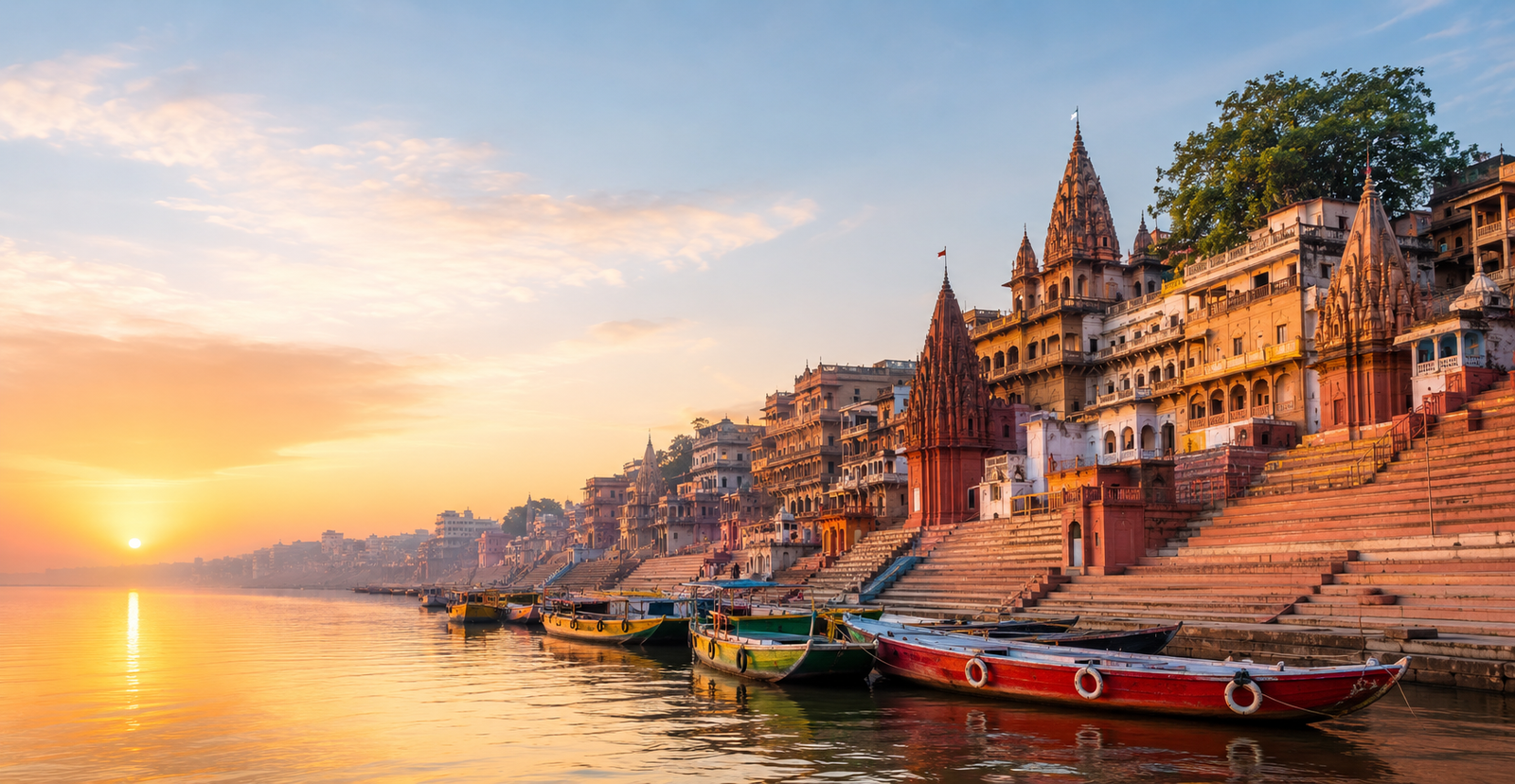
Varanasi — also known as Kashi or Banaras — is one of the oldest continuously inhabited cities on earth and the spiritual heart of India. Sitting on the western bank of the holy Ganges, it is a place where life and faith unfold in the open: pilgrims bathing at dawn, priests swinging fire lamps at dusk, boats gliding past centuries-old ghats, and narrow lanes humming with temples, silk shops and the aroma of hot kachoris. For a first-time visitor, all of this can feel wonderful but overwhelming, which is exactly why a well-planned Varanasi tour package is so popular. This detailed guide walks you through everything you need to know before you go — what a package includes, how much it costs, how many days you need, the best time to visit, how to reach the city, where to stay, what to eat, and the tips that make the difference between a rushed visit and a truly memorable one.
A Varanasi tour package is a pre-planned trip that usually bundles hotel stay, transfers, Kashi Vishwanath darshan, the evening Ganga Aarti, a sunrise boat ride on the Ganges and often a half-day trip to Sarnath. Packages generally cost ₹9,000 to ₹25,000 per person, and 2–3 days is enough to cover the essentials of Kashi.
The basicsWhat is a Varanasi tour package?
A Varanasi tour package is a ready-made travel plan for Kashi in which accommodation, sightseeing and local logistics are arranged for you in advance. Rather than separately booking a hotel, arranging transport, hunting for a boatman and figuring out temple and aarti timings, everything is organised around a set number of days and a fixed set of experiences. Packages are usually priced per person on twin-sharing and can be tailored to your travel style, whether you are a devout pilgrim focused on darshan and pooja, a family wanting comfort and a relaxed pace, or a curious traveller keen on the culture, history and photography of the ghats.
The appeal is practical. Varanasi’s old city is a dense web of lanes where cars cannot go, addresses are informal, and the same street can lead you to a temple, a silk workshop and a cremation ghat within a few minutes. A package removes that friction. A good local operator knows which darshan queue is moving, when the aarti crowd swells, where a boat can be boarded safely, and how to slot Sarnath into a half-day without wasted time. That local knowledge is the real value — you spend your energy on the experience, not the logistics.
Package vs DIYWhy choose a package over planning everything yourself
Independent travel in Varanasi is absolutely possible, and many backpackers love the freedom of wandering the ghats at their own pace. But there are good reasons a large share of visitors — especially families, senior citizens and first-timers — prefer a structured package.
- Time efficiency. With only two or three days, a planned route ensures you don’t miss the Vishwanath darshan window or the evening aarti while searching for directions.
- Comfort and safety. Pre-arranged transfers and a guide reduce the stress of haggling with rickshaws or navigating crowds, which matters most for older travellers.
- Local access. Operators often smooth the darshan process, arrange a reliable boatman and know quieter times to visit popular spots.
- Predictable cost. A bundled price makes budgeting easier and avoids surprise charges during peak season.
The trade-off is a little less spontaneity. If you value complete flexibility and have time to spare, doing it yourself works well. If you want a smooth, worry-free spiritual trip, a package earns its keep.
InclusionsWhat a Varanasi tour package usually includes
Inclusions vary between operators and price tiers, but a standard package generally covers most of the following:
- Accommodation — hotel stay, often close to the ghats or the railway station, usually with daily breakfast.
- Kashi Vishwanath darshan — a guided visit to one of the twelve sacred Jyotirlingas through the Kashi Vishwanath Corridor.
- Ganga Aarti — the spellbinding evening ceremony of lamps, conches and chants at Dashashwamedh Ghat.
- Sunrise boat ride — a morning row or motorboat along the ghats, the single most iconic experience in the city.
- Sarnath excursion — a half-day trip to the Buddhist site around 10 km from the centre.
- Transfers — airport or railway station pickup and drop, plus sightseeing transport.
- Local guide — a knowledgeable guide for the ghats, temples and old city.
Common optional add-ons include VIP or Sugam Darshan, a Rudrabhishek or Ganga pooja, a subah-e-Banaras (morning cultural programme) session at Assi Ghat, and extensions to nearby pilgrimage towns such as Ayodhya and Prayagraj. Always confirm whether lunch and dinner, entry tickets and the boat fee are included or extra, since this is where package prices differ most.
Choose your tripTypes of Varanasi itineraries
Most travellers pick from three broad formats depending on how much time they have and whether they want to add nearby destinations.
| Itinerary | Duration | Best for | Covers |
|---|---|---|---|
| Kashi Essentials | 2N / 3D | Short weekend darshan | Vishwanath, Ganga Aarti, boat ride, ghat walk |
| Kashi + Sarnath | 3N / 4D | Families & first-timers | Above + Sarnath, Ramnagar Fort, BHU, Assi Ghat |
| Pilgrimage Circuit | 5N / 6D | Complete pilgrimage | Above + Ayodhya and Prayagraj (Triveni Sangam) |
For a first visit, the 3–4 day option strikes the best balance: enough time to soak in Kashi without rushing, plus the calm, green contrast of Sarnath. If your trip is primarily religious, the longer circuit that adds Ayodhya’s Ram Mandir and Prayagraj’s Triveni Sangam turns your journey into a broader north-Indian pilgrimage.
Day by dayDetailed sample itineraries
The classic 2-day (short) itinerary
Ghats & the grand Ganga Aarti
Arrive, check in and rest. Late afternoon, walk from Assi Ghat towards Dashashwamedh, then watch the Ganga Aarti in the evening. End with street food around Godowlia.
Sunrise boat ride & Vishwanath darshan
Early boat ride for sunrise, followed by Kashi Vishwanath darshan and a walk through the old lanes. Depart in the afternoon.
The recommended 3-day itinerary
Ghats & the grand Ganga Aarti
Settle in, then experience the evening Ganga Aarti at Dashashwamedh Ghat and try local Banarasi snacks around Godowlia and Kachori Gali.
Sunrise boat ride & Vishwanath darshan
Begin at dawn with a boat ride to watch the sun rise over the ghats, then Kashi Vishwanath darshan. Spend the afternoon exploring the old lanes, Manikarnika Ghat and the silk-weaving quarter.
Buddhist Sarnath & departure
Half-day trip to Sarnath — the Dhamek Stupa, the archaeological museum and Mulagandha Kuti Vihar — before heading home.
The extended 5–6 day pilgrimage itinerary
Travellers wanting a fuller circuit typically spend the first two to three days in Varanasi as above, then take a day trip or overnight to Ayodhya for Ram Mandir darshan, and a day at Prayagraj for the Triveni Sangam — the confluence of the Ganga, Yamuna and the mythical Saraswati — with a short boat ride to the meeting point of the rivers. This longer plan suits pilgrims and multigenerational family groups who want to combine several sacred sites in one trip.
SightseeingTop places to visit in Varanasi
Beyond the headline experiences, Varanasi rewards curiosity. Here are the places most worth building into your itinerary.
Kashi Vishwanath Temple
The spiritual centrepiece, dedicated to Lord Shiva and home to one of the twelve Jyotirlingas. The corridor to the Ganges has made access far smoother; early morning is usually calmer.
Dashashwamedh Ghat
The most famous and liveliest ghat, and the venue for the grand evening Ganga Aarti — fascinating to watch even outside aarti hours.
Manikarnika & Harishchandra
The main cremation ghats, where Hindus believe cremation grants moksha. Deeply solemn places — observe quietly and avoid photography.
Assi Ghat
The calm southernmost ghat, popular for the morning subah-e-Banaras programme of music, yoga and a smaller aarti. A lovely place to start the day.
Sarnath
About 10 km away, where Buddha gave his first sermon. Highlights include the Dhamek Stupa, monastery ruins, a fine museum and Mulagandha Kuti Vihar.
BHU & New Vishwanath
One of Asia’s largest universities, with a leafy campus, the Bharat Kala Bhavan art museum and the marble New Vishwanath (Birla) Temple, open to all.
Ramnagar Fort
Across the river, the 18th-century home of the Maharaja of Banaras, with a faded museum of vintage cars, palanquins and armoury.
Tulsi Manas & Durga Kund
A cluster of temples worth seeing: the marble Tulsi Manas, the Durga Temple beside its historic tank, and the unusual Bharat Mata Temple with its relief map of India.
UnmissableThe Ganga Aarti experience
If you do only one thing in Varanasi, make it the evening Ganga Aarti at Dashashwamedh Ghat. Every night after sunset, a row of young priests in matching robes perform a synchronised ritual, swinging large brass lamps of fire, blowing conch shells and chanting hymns while incense drifts over the river and bells ring across the water. The atmosphere is electric and moving in equal measure. Arrive at least 30 to 45 minutes early for a good spot, or better still, watch from a boat on the river, where the whole ghat glows before you. A smaller, more intimate aarti also takes place at Assi Ghat, which is worth seeing if you have time.
Watch the aarti once from the steps and once from a boat — from the water, the entire ghat glows like a wall of fire reflected on the Ganges.
A traveller’s tipAt first lightThe sunrise boat ride
The other unmissable experience is a boat ride at dawn. As the first light spreads across the sky, the ghats turn gold, pilgrims descend the steps to bathe, and diyas float on the water. Gliding slowly along the riverfront, you see the city from the angle it was built to be seen — from the Ganges looking back. Rowboats are quieter and more atmospheric than motorboats, and early morning offers the calmest water and softest light. Many travellers rate this the most peaceful hour of their entire trip.
Day tripA half-day in Sarnath
Just 10 km from the intensity of the old city, Sarnath is a gentle, green counterpoint. This is one of Buddhism’s four holiest sites, marking where the Buddha first taught the dharma. You can comfortably see the main sights in half a day: the massive Dhamek Stupa, the ruins of ancient monasteries, the Ashoka Pillar site, the modern Mulagandha Kuti Vihar with its beautiful frescoes, and the archaeological museum that houses the famous Lion Capital of Ashoka — the emblem of the Republic of India. It is a restful, reflective addition to any Varanasi trip.
BudgetHow much does a Varanasi tour package cost?
Costs depend on the season, the hotel category and the number of days. As an indicative guide for 2026, a 2 Nights / 3 Days trip on twin-sharing with a 3-star hotel usually starts around ₹9,000–₹12,000 per person. A 3 Nights / 4 Days package that adds Sarnath and a couple more sights typically ranges from ₹13,000 to ₹18,000 per person, while longer circuits including Ayodhya and Prayagraj can reach ₹25,000 or more. The main factors that move the price are:
- Hotel category — budget guesthouses versus 3-, 4- or 5-star hotels near the ghats.
- Season — peak festival periods such as Dev Deepawali and Mahashivratri command higher rates.
- Group size — per-person costs usually fall as the group grows because transport and guide fees are shared.
- Inclusions — whether meals, entry tickets, boat fees and VIP darshan are bundled or charged separately.
When to goBest time to visit Varanasi
The best time to visit Varanasi is from October to March, when cool, pleasant weather makes ghat walks, boat rides and long darshan queues comfortable. Winter mornings on the Ganges are especially atmospheric, though December and January can bring dense morning fog that occasionally delays flights and trains.
Here is a quick season-by-season view to help you plan:
| Season | Months | What to expect |
|---|---|---|
| Winter (peak) | Oct – Mar | Best weather; ideal for sightseeing and festivals; book early |
| Summer | Apr – Jun | Hot and dry; fewer crowds; early mornings only |
| Monsoon | Jul – Sep | Fuller river and lush surroundings; occasional boating limits |
If you can time your visit with a festival, Dev Deepawali (on the full moon in November) is unforgettable, when thousands of lamps light up every ghat. Mahashivratri (February–March), Ganga Mahotsav and Holi are also vivid times to experience the city, though crowds and prices rise sharply, so plan and book well ahead.
Getting thereHow to reach Varanasi
Varanasi is very well connected, which is one reason it is such an easy destination to add to a north-India trip.
- By air: Lal Bahadur Shastri International Airport (VNS) is about 25 km from the city and has flights from Delhi, Mumbai, Bengaluru, Hyderabad, Kolkata and other major cities, plus some international routes.
- By train: Varanasi Junction (BSB, also called Varanasi Cantt) and the newer Banaras station (BSBS, Manduadih) are major railheads with connections across India. Trains are often the most convenient and scenic option.
- By road: National highways link Varanasi to Lucknow, Prayagraj, Gorakhpur, Kanpur and Ayodhya, and long-distance buses and taxis are readily available.
Within the city, autos and cycle-rickshaws are the norm, but remember that most of the old city and the ghats are pedestrian-only, so expect to walk the final stretch to your riverside hotel or temple.
AccommodationWhere to stay in Varanasi
Where you stay shapes the feel of your trip. Broadly, there are three good options:
- Near the ghats (old city): Riverside guesthouses and heritage hotels around Assi Ghat, Dashashwamedh and the surrounding lanes put you steps from the aarti and boats. Atmospheric, but access is on foot through narrow alleys.
- Cantonment / Cantt area: Near the railway station, this area has most of the branded 3- to 5-star hotels, wider roads and easy transport — a comfortable choice for families and older travellers.
- Assi Ghat neighbourhood: A calmer, slightly bohemian pocket popular with longer-stay visitors, cafés and the morning subah-e-Banaras.
If experiencing the ghats at first light is your priority, stay as close to the river as possible. If comfort, parking and easy arrivals matter more, the Cantonment area is the safer bet.
Taste of KashiWhat to eat in Banaras
Banarasi food is a highlight in its own right, rooted in a rich street-food culture. A few things to seek out:
- Kachori-sabzi — the classic Banarasi breakfast of crisp kachoris with spiced potato curry.
- Tamatar chaat & chooda-matar — tangy, spicy street snacks the city is famous for.
- Malaiyo — a delicate, saffron-tinged milk foam dessert available only on winter mornings.
- Banarasi paan — the iconic after-meal betel leaf, practically a cultural institution here.
- Lassi & jalebi — thick, creamy lassi served in clay cups, and hot jalebis fresh from the pan.
The lanes around Godowlia, Kachori Gali and the Chowk area are the best hunting grounds. Choose busy, popular stalls for freshness, and stick to bottled or filtered water.
Take homeShopping in Varanasi
Varanasi is world-famous for its handwoven Banarasi silk sarees, prized for their gold and silver zari work and intricate brocade. Genuine handloom pieces are an investment, so buy from reputable showrooms or cooperative outlets and be wary of very cheap “silk” that is often powerloom or synthetic. Beyond textiles, look for wooden toys and lacquerware, brassware, glass-bead jewellery, and religious items such as rudraksha malas. Bargaining is expected in the smaller shops of the old city, though fixed-price showrooms are more predictable for high-value purchases.
Good to knowTravel tips & etiquette
- Dress modestly for temple visits and carry footwear that is easy to slip off.
- Reach the aarti early — Dashashwamedh Ghat fills quickly; a boat gives the best, calmest view.
- Book the boat ride at dawn for the softest light and gentlest water.
- Respect the cremation ghats — do not photograph funerals; observe quietly.
- Keep valuables secure in the crowded lanes, and agree fares before starting a rickshaw ride.
- Stay hydrated and use bottled or filtered water, especially in warmer months.
- Be polite but firm with unsolicited “guides” near temples; use your package guide or a verified one.
- Carry small change for offerings, boats and street food.