
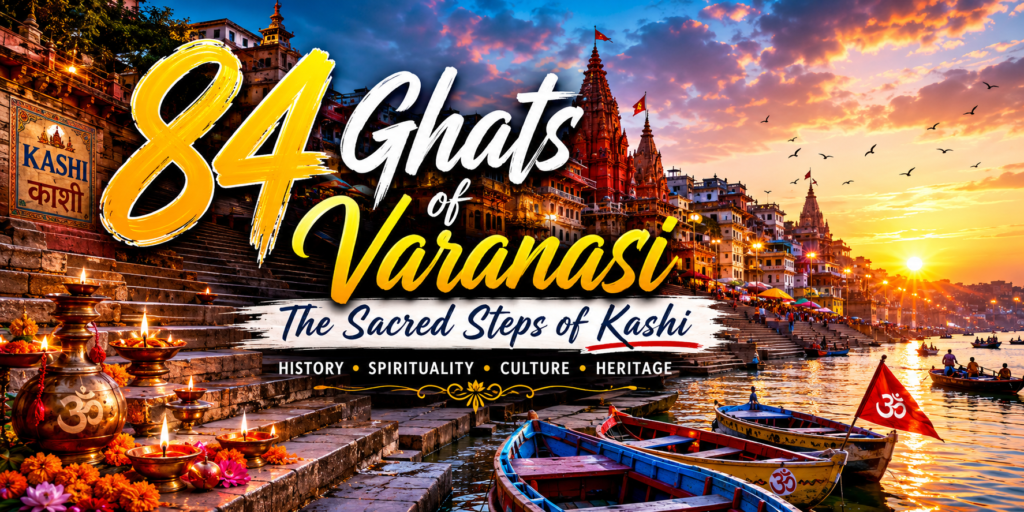
84 GHATS OF VARANASI
काशी · Kashi
All 84 Ghats of Varanasi
The Complete Sacred Waterfront of Kashi
Walk the most spiritual shoreline in the world. Every ghat along the Ganges in Varanasi carries centuries of prayer, ritual, and living heritage. This is your definitive guide to all 84 ghats.
The Sacred Waterfront
Why Varanasi’s Ghats Are Like No Place on Earth
Stretching for approximately 6.5 kilometres along the western bank of the Ganges, the 84 ghats of Varanasi represent the heartbeat of one of humanity’s oldest living cities. A ghat is a broad flight of stone steps leading down to the river — but calling them just steps would be like calling the Himalayas just hills. Each ghat is a stage for birth, death, prayer, commerce, and celebration, unfolding simultaneously and without pause, every single day.
Pilgrims come to bathe in the Ganges, believing the sacred water washes away sin. Sadhus meditate on the steps. Fishermen cast nets at dawn. Wrestlers train at Tulsi Ghat. Musicians perform at Assi. Silk merchants negotiate near Mir Ghat. And at Manikarnika, the fires of cremation have never gone out — not for a single day — for over three thousand years.
The Complete List
All 84 Ghats of Varanasi
No ghats match your search. Try a different name.
What Is a Ghat?
The word ghat comes from Sanskrit, meaning a stairway or stepped embankment leading down to a body of water. In the context of Varanasi, each ghat is a distinct sacred zone with its own deity, presiding priest lineage, mythology, and cultural character.
Most ghats were originally earthen slopes. Over centuries, local maharajas, merchants, and religious trusts rebuilt them in stone — primarily the locally quarried Chunar sandstone — giving the waterfront its signature amber-ochre palette that glows gold at sunrise.
The number 84 itself is deeply significant in Hinduism. It represents the 84 lakh (8.4 million) life forms the soul may inhabit before achieving liberation (moksha), and it echoes across Indian sacred geography.
Practical Tips for Visiting
- Arrive at dawn for the best atmosphere — the lighting on the river at 5:30 AM is breathtaking.
- Book a wooden rowing boat from Dashashwamedh to cover all ghats in 90 minutes at sunrise.
- Evening Ganga Aarti at Dashashwamedh Ghat begins around 6:30–7 PM; arrive 30 minutes early for a good spot.
- Dress modestly, especially near temples and cremation ghats. Photography at Manikarnika requires respectful discretion.
- Walk south to north (Assi to Adi Keshava) for a complete pilgrimage — this is the traditional Pancha-kroshi route.
- October to March is the ideal season; summer (April–June) is intensely hot, and monsoon can flood lower steps.
- Hire a local ghat guide for deeper stories — most are remarkably knowledgeable and multilingual.
Common Questions
Frequently Asked Questions
Varanasi officially has 84 ghats along the western bank of the Ganges. They stretch approximately 6.5 kilometres from Assi Ghat in the south to Adi Keshava Ghat in the north. Some sources count slightly differently depending on whether smaller subsidiary steps between major ghats are included, but 84 is the universally accepted traditional number — significant because 84 represents the 84 lakh life forms in Hindu cosmology.
Dashashwamedh Ghat is the most famous and the spiritual centre of Varanasi. Located near the Vishwanath Temple, it is the site of the spectacular daily Ganga Aarti ceremony performed every evening by a team of priests. The aarti features large brass lamps, conch shells, flowers, and chanting, and draws thousands of visitors and devotees every night. Mythologically, it is where Lord Brahma performed the Dashashwamedha yajna (ten-horse sacrifice).
There are two main cremation (shamshan) ghats in Varanasi. Manikarnika Ghat is the principal and most sacred one, where cremations have reportedly continued without interruption for over three thousand years. Hindus believe dying in Varanasi and being cremated at Manikarnika grants direct liberation (moksha) from the cycle of rebirth. Harishchandra Ghat is the second cremation ghat, smaller but equally ancient, named after the legendary truth-telling King Harishchandra who worked there as a cremation attendant.
There are two unmissable times of day. Early morning (5:00–7:30 AM) is the most atmospheric — devotees bathe in the golden light, yogis practise on the steps, and the river mist creates an otherworldly scene. The sunrise boat ride covering all ghats is a travel experience that stays with you for life. Evening (6:00–8:00 PM) is when the Ganga Aarti at Dashashwamedh Ghat transforms the riverfront into a sea of light and chanting. For the overall visit, October to March offers the most comfortable weather.
Yes, it is entirely possible to walk along the ghats from Assi Ghat to Adi Keshava Ghat. The full distance is roughly 6.5 kilometres along the riverbank. Most visitors cover it comfortably in 2–3 hours on foot during the cooler months, stopping at notable ghats along the way. However, during monsoon season (July–September), lower steps of some ghats can be submerged, making a continuous walk difficult. A boat ride at dawn is the most popular way to see all ghats at once.
Dashashwamedh Ghat is the most popular departure point for sunrise boat rides, as it is centrally located and has the largest fleet of wooden rowboats for hire. Assi Ghat is also a common starting point for travellers staying in the southern guesthouses. From either ghat, a full sunrise journey northward past all major ghats to Adi Keshava and back takes approximately 90 minutes to 2 hours. Rates are negotiable but typically range from ₹200–₹600 per person depending on boat size and route.
Assi Ghat is the centre of yoga and wellness culture in Varanasi. Every morning at sunrise, yoga classes are held on its wide steps, drawing both international travellers and local practitioners. The ghat also marks the traditional starting point of the sacred Pancha-kroshi pilgrimage. Tulsi Ghat is known for its pehlwani (traditional Indian wrestling) akhara. And Kedar Ghat is popular among early-morning meditators for its comparatively calm and spiritual atmosphere.